

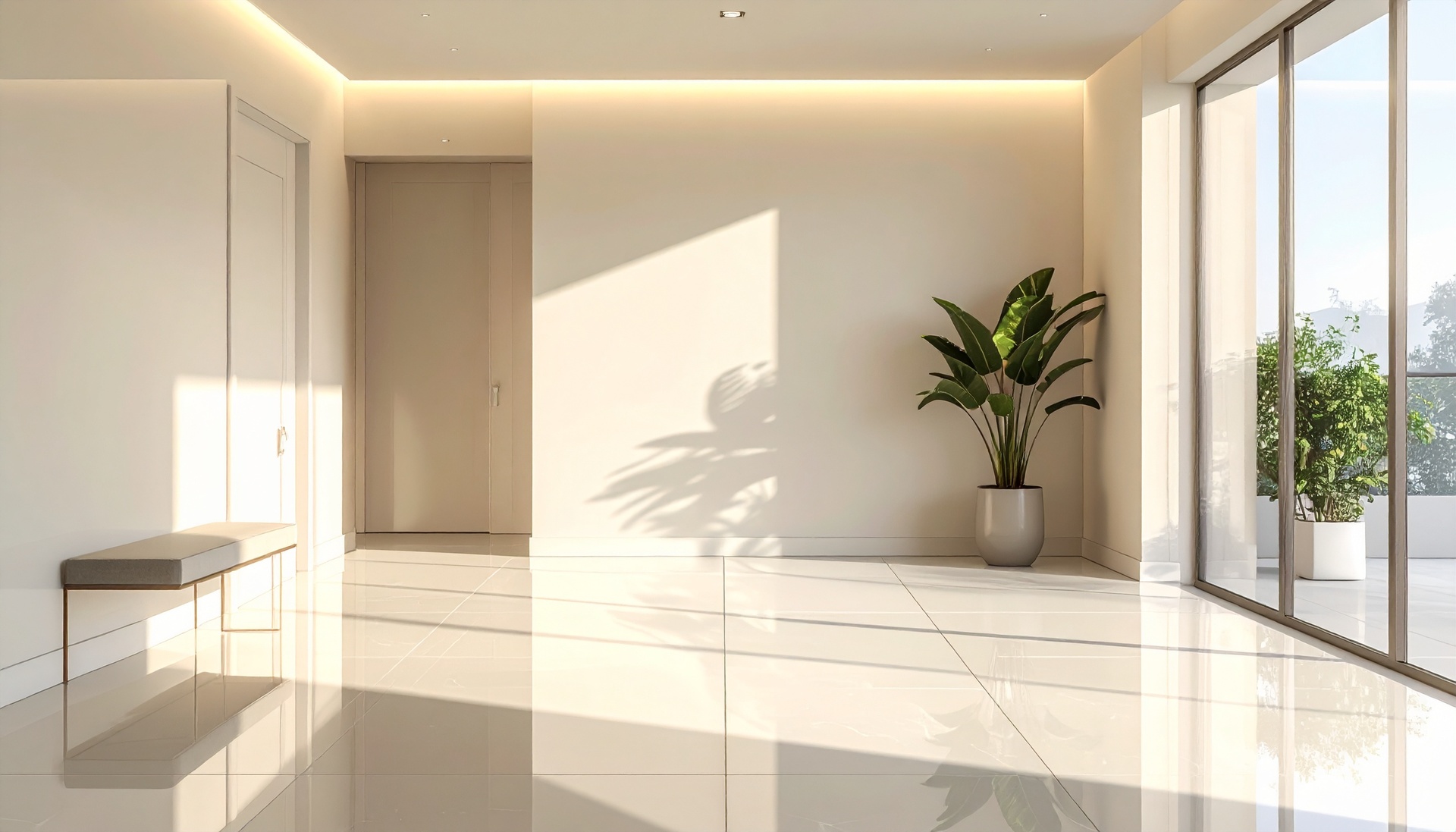
There is a quiet trick that designers have been using for years in compact spaces, and it has nothing to do with mirrors, light paint colors, or removing walls. It lives on the floor. Specifically, it lives in the grout lines, or more accurately, in the absence of them. Large format tile has become one of the most powerful tools in the design playbook for smaller homes, and in Austin, where square footage comes at a serious premium, it is a conversation worth having.
Why tile size changes everything in a room
Most homeowners think about tile in terms of pattern and color. Size rarely enters the conversation early enough. But the dimensions of your tile flooring have a direct and measurable effect on how large or small a room feels, and understanding that relationship is the difference between a space that opens up beautifully and one that feels visually choppy no matter what else you do.
The grout line effect and why fewer lines mean more floor
Here is the core principle. Every grout line is a visual interruption. When a floor is covered in 12x12 tiles, a standard bathroom or kitchen contains dozens of those lines running in every direction. The eye reads each one as a stopping point, which subconsciously registers the space as smaller and more fragmented than it actually is.
Switch to a 24x24 tile in that same room and you immediately cut the number of grout lines by roughly 75 percent. Switch to a 24x48 plank-format tile and the floor begins to read almost as a single continuous surface. The room doesn't get any bigger. It just stops telling your eye where to stop.
How Austin homes specifically benefit
Austin's housing market has pushed a lot of homeowners into smaller footprints, whether that's a thoughtfully designed home in Bee Cave, a compact newer build in Cedar Park, or a charming older home in Westlake that was never meant to feel open-concept. In all of these cases, large format tile does something that no renovation short of demolition can replicate: it borrows visual space.
When large tiles run continuously from the kitchen into a living area or from a hallway straight into a bathroom, the transition disappears. Separate rooms start to feel like one flowing space. This is especially valuable in homes where the square footage simply cannot be changed but the feel of the space absolutely can.
The layout direction matters just as much as the size
A 24x48 tile installed with the long side running parallel to the longest wall in the room will make that wall feel like it stretches further. Rotate it 90 degrees and you can widen a narrow room visually. A 24x24 tile set on a diagonal adds movement and draws the eye outward toward the corners, which tricks the brain into perceiving more depth. These are not small differences. In a room under 200 square feet, the right layout direction can make the space feel like a completely different room. This is precisely the kind of detail that comes up in a professional tile flooring in Austin conversation, and it is also why layout planning deserves just as much attention as tile selection.
The grout color conversation nobody has early enough
Large format tile gives you fewer grout lines, but the color of those lines still matters. A tight grout joint in a tone that closely matches the tile creates the most seamless, expansive look possible. A contrasting grout, while beautiful in its own right, reintroduces the grid pattern that large tile was chosen specifically to minimize. Neither choice is wrong. But it is a decision that should be made deliberately, with the full floor layout in mind, not as an afterthought at the end of a tile installation.
What installation precision means for large tiles
Large format tiles are less forgiving than small ones when the subfloor is not perfectly level. A slight variance that would disappear under a 12x12 tile becomes visible as a lip or a rock under a 24x48 slab. This is not a reason to avoid them. It is a reason to work with a flooring company that takes subfloor preparation as seriously as the tile selection itself, which is exactly what a thorough design consultation at Lakeway Floors is built around. Our team walks you through the full picture before a single tile is ordered, because the details that happen before installation are just as important as the ones that happen during it.
The rooms where large format tile delivers the most impact
Kitchens and open living areas are the obvious candidates, but large format tile performs beautifully in primary bathrooms, laundry rooms, and entryways as well. In fact, a continuous large format tile running from an entry through a hallway and into the main living area is one of the most effective ways to make the entire ground floor of a smaller home feel considerably more expansive. It is a single material choice that improves the feel of multiple rooms at once.
See the difference for yourself
Lakeway Floors serves homeowners across the greater Austin area, from Westlake and Bee Cave to Dripping Springs, Leander, Horseshoe Bay, and Marble Falls. If your home feels smaller than it should, a conversation about large format tile might be exactly where to start. Browse our tile store and schedule your free in-home consultation today.


